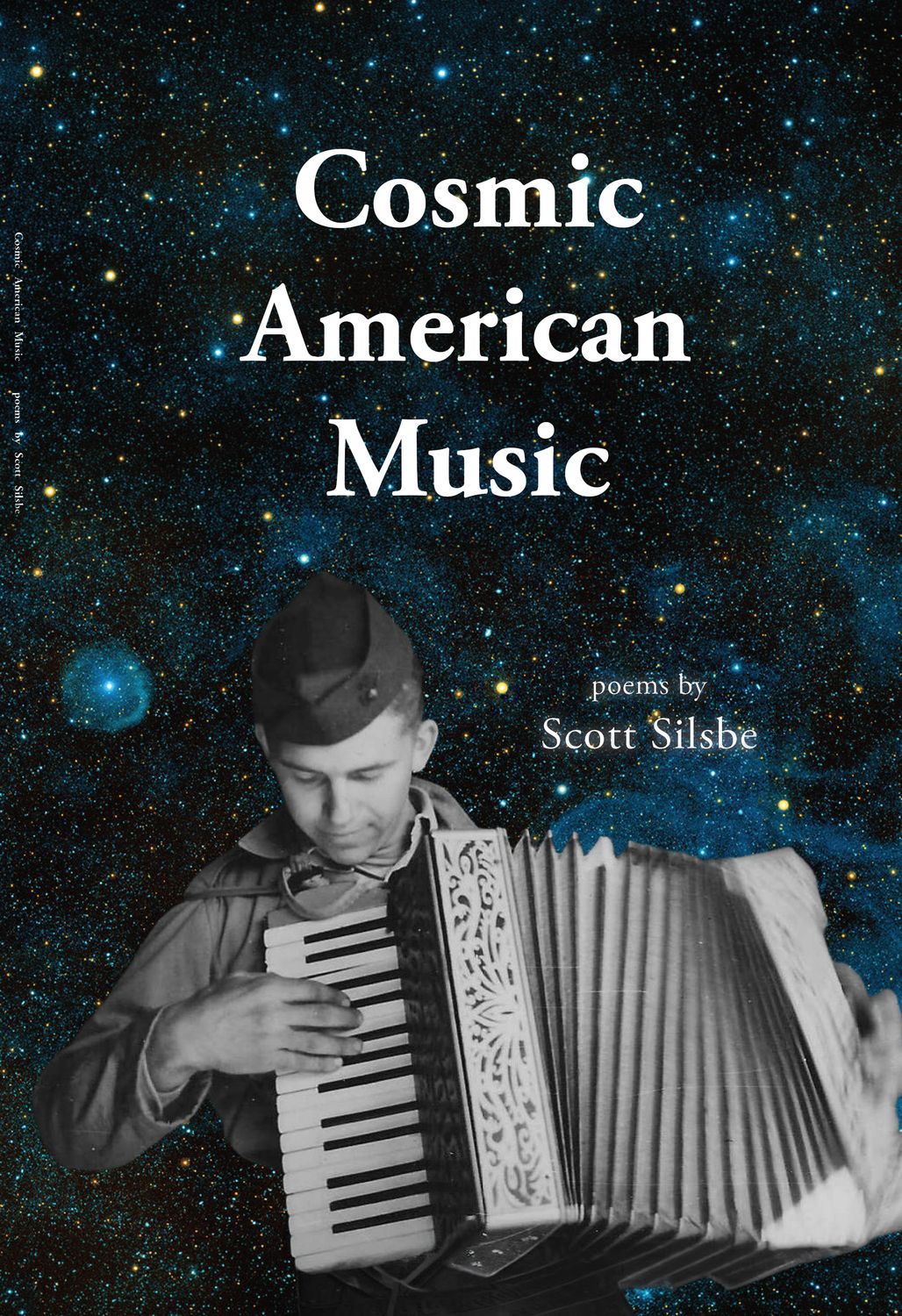
COSMIC AMERICAN MUSIC
$15.00
In Stock and Ready to ship!
In stock
Save this product for later
COSMIC AMERICAN MUSIC
Product Details
UPC: ISBN: 979-8-950070-03-7 (Paperback)
Brand: Seed Bed Press, Inc.
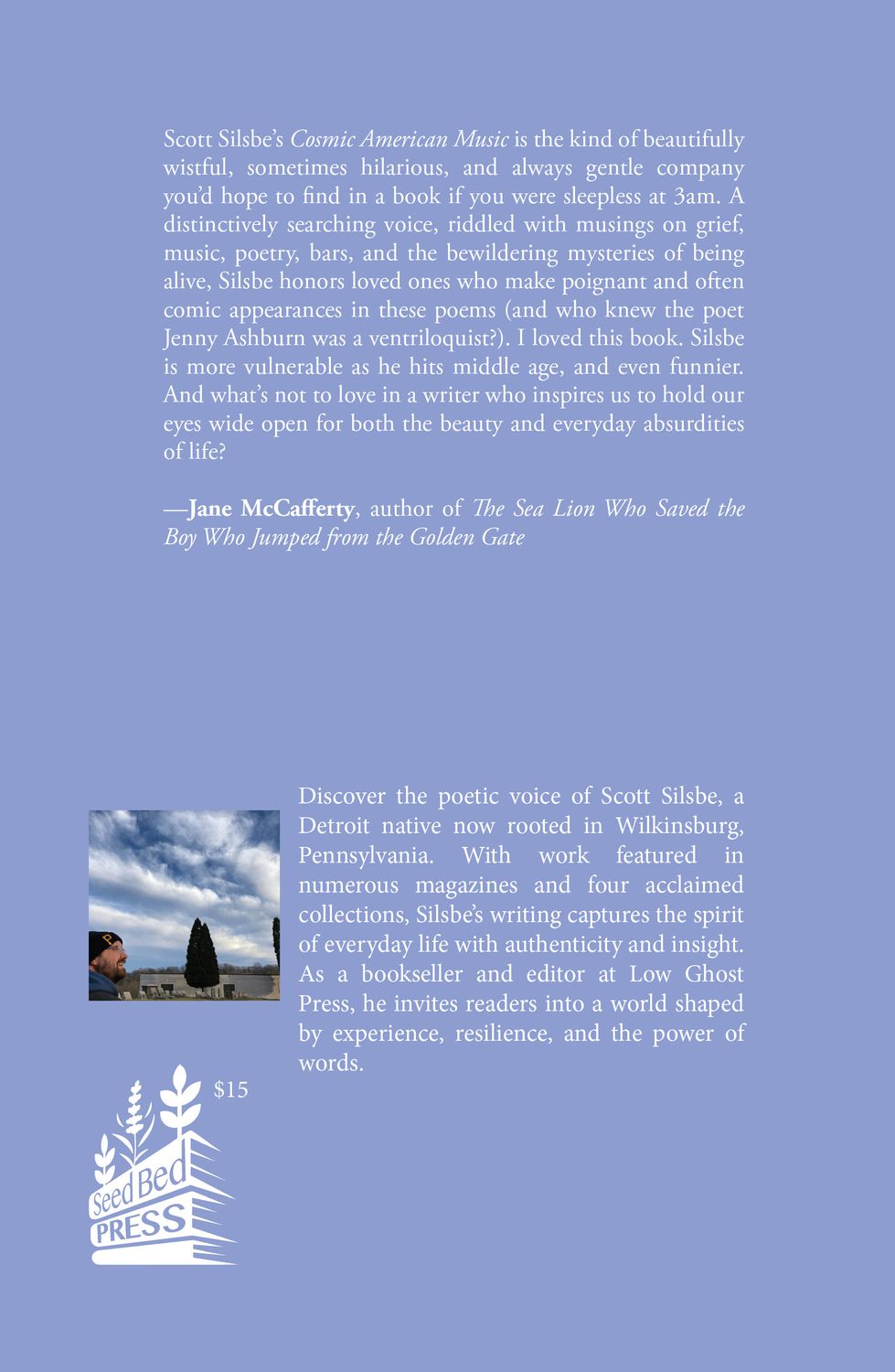
Scott Silsbe’s Cosmic American Music is the kind of beautifully wistful, sometimes hilarious, and always gentle company you’d hope to find in a book if you were sleepless at 3am. A distinctively searching voice, riddled with musings on grief, music, poetry, bars, and the bewildering mysteries of being alive, Silsbe honors loved ones who make poignant and often comic appearances in these poems (and who knew the poet Jenny Ashburn was a ventriloquist?). I loved this book. Silsbe is more vulnerable as he hits middle age, and even funnier. And what’s not to love in a writer who inspires us to hold our eyes wide open for both the beauty and everyday absurdities of life?
—Jane McCafferty, author of The Sea Lion Who Saved the Boy Who Jumped from the Golden Gate
I’ve been fortunate enough over the last several years to know Scott Silsbe and his intricate flowing river of words. And while, in the past, I’ve often found Silsbe’s work to be almost as delicate as a tea cup in a steel mill—in the way Jim Daniels can be delicate, or perhaps Edward Field—I think that was just his way of trying to find parts of himself that he hadn’t yet explored, it was the search to find his rougher edges. And in this most recent collection, Cosmic American Music, I truly believe Silsbe has come full circle and that he is now completely comfortable in his own skin—it is that ease that shines through like a Rust Belt ballet. So all I can say is, put away your fine china, because that’s not the world most of us currently occupy. Least of all Silsbe. Things get messy here and, in my opinion, this book is Scott at his best. It is a fitting tribute to the grittiness of the streets of Pittsburgh that you can feel in your bones. The dirt under Silsbe’s fingernails finally feels like his own, so just keep reading—I certainly intend to. And hopefully we can all come out a little cleaner on the other side.
—John Dorsey, author of 100 Mornings
About the Author
Scott Silsbe was born in Detroit. He now lives in Wilkinsburg, Pennsylvania, where he works as a bookseller. His poems and prose have appeared in numerous magazines and have been collected in four previous books—Unattended Fire, The River Underneath the City, Muskrat Friday Dinner, and Meet Me Where We Survive. Silsbe is also the editor of Low Ghost Press.
If I Don’t Consider the Burning
Reviewed in the United States on August 22, 2026
5 out of 5 Stars
If I Don’t Consider the Burning
Reading Scott Silsbe’s Cosmic American Music
“Isn’t it pretty? Scott Silsbe asks in the opening line, of the opening poem, in his fifth full-length poetry collection, Cosmic American Music (Seed Bed Press, 2026). “Isn’t it pretty? The neutron star collapsing, balancing over the black ocean.” A master of the understated, like Appollinaire and Jack Gilbert, Silsbe’s poems sing of the mundane and every day, and transform them into something magical, something almost cosmic, like “Thai Basil,” “It Wasn’t a Dream It Was a Flood,” and “Sunday Afternoons,” where the speaker, dressed in his bathrobe, sips coffee while reading Fat City and listening to Chopin, as the “snow piles up/out in the streets/and cars spin/wildly out of control.
Music is also a big part of Silsbe’s life. It not only seeps into his poems, but at the back of the book, in the acknowledgements section, he lists “a stack of records that assisted with the writing of this book.” Some of these records include Max Richter’s Infra, Hania Rani’s Music for Theatre and Film, U.F.O. by Jim Sullivan, and Spiritualized’s Ladies and Gentlemen, We Are Floating in Space.
Outer Space, the universe, and our smallness in relation to it, serve as recurring motif, as does the bewilderment we all, sometimes feel, living in this modern, media-saturated, post-COVID world, where we are impermanent.
Poems like “Orbital Perspective,” “Tapestry from an Asteroid,” “We are Dead Stars Looking Back Up at the Sky,” and “The Poetics of Outer Space,” where the speaker admits that he likes to be “in my own world/but I also like to be/a part of the world/I inhabit,” show the fleetingness of our lives, where “every day something else/we love or value disappears,” and that no matter how hard we try to protect ourselves, through our friendships, loves and our possessions, there is no escaping this impermanence.
Yet, along with the confusion and dread that leads us to “dark places,” where “only sometimes” do we feel completely free from the burden of what we’ve done, and what’s been done to us, even if it is of our own making, there is humor, gratitude, and love; poems that like “Campfire Songs,” “Spinning Punk Rock Records for My Mother on Boxing Day,” and “Supermoon Tonight,” that celebrate family.
The City of Pittsburgh, and particularly Wilkinsburg, where Silsbe lives and works as a bookseller, show up in many of these poems; poems like “Cosmic Joke,” “The Night the Stars Fell,” and “Coltrane at the Cage,” celebrate friendships and favorite bars.
There is also Silsbe’s love of the quirky and absurd, for that happened upon poem or line like “Curtis is not welcome,” a sign behind the bar in the poem “Thursday Night at the R Bar in Dormont,” or the poem where Bobby tells of his search for Whippets in a Vegas porn store, poems like “Eat that Ice Cream,” “Pajich Haikus,” and “Ive Never Been to Shoshone Falls,” where “Jenny says, ‘Do you know how hard it is to kill an elk?’
Reading these poems, you will also discover that Scott Silsbe is, at heart, a romantic. Take “Listening to Music with You:” where the speaker confesses that “Some days I feel Like I’m breaking wide open/and that my insides are completely exposed. /But there are those times where I am just/listening to music with you.” And later… “And there’s something about your presence/that changes the music—makes it more, makes it greater than, enhances it, I guess.” Until the speaker concludes in a moment of contentment, that “Right now, I don’t seem to want anything else.”
“Some nights,” he writes in “Archipelago,” “I’m the only one on the dancefloor./And sometimes, it seems like I’m on fire/and no one notices.” And later he admits “I am only alone and misguided if I don’t/consider the burning.” Maybe, that’s the key for all of us. Cosmic American Music is Silsbe’s most succinct collection. It traverses the firmament, taking the reader on a ride of emotions, and leaving them in the end, satiated, knowing that we are not alone, not in our apartments, in our neighborhoods and cities, not in the world, or even out there among the stars. Reading these poems, which I hope you do repeatedly, you should find comfort in knowing we are all searching for a light in the darkness.
5 out of 5 stars
Silsbe At His Best!
Reviewed in the United States on August 22, 2026
I'm a huge fan of Scott Silsbe's poems, and I consider him one of the best poets out there. This is another terrific collection. His previous books are a mix of narrative and lyric poems, heavy on the narrative, detailing themes (and things) he loves and endures: music, books, friends, family, money, booze, work. Cosmic American Music is an extension of his previous books but this one feels more lyrical than narrative, sometimes using emotion to lead into the narrative, rather than the narrative leading to the emotion. These poems are about finding the light in an endless space of darkness. As a reader, I could feel the unmentioned spaces that happened before the poems--the sadness or depression or whatever you want to call it. Hemingway would love the way Silsbe uses the iceberg--we don't need to hear about all the problems, only that there are problems. These poems remind us that pain is inevitable but never permanent, especially if you allow the light in, which Silsbe does with art, friendship, and family. The last poem is about the moon, and how knowing beauty is out there matters, whether you happen to look up or not. A perfect ending to an excellent collection.
You May Also Like




Streets September 15, 2026

Grief is a Place with a Hole Inside
Grief is a Place with a Hole Inside
Preorder to receive your copy AHEAD OF STREET DATE!
SKU Jay Orlando
$15.00

Street Date October 12, 2026
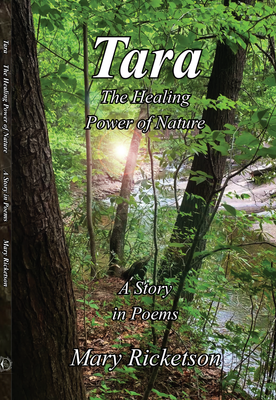
TARA: The Healing Power of Nature
TARA: The Healing Power of Nature
Preorder now for early reception! Help the author earn the highest royalties!
SKU Mary Ricketson
$15.00